Electric Curtains for Disabled and Less Mobile People

Reviewed by David Coleman, Website Manager
Reviewed 7 May 2026
When Curtains Become a Daily Struggle
Opening and closing curtains sounds simple. For most people it takes a few seconds and they never think about it. But for someone with rheumatoid arthritis, a degenerative condition, a spinal injury, or reduced strength after surgery, the same action can be genuinely painful or simply impossible. Heavy curtains on stiff tracks are a particular problem. Even lightweight ones on a long rail can mean repeated reaching, pulling, and adjusting throughout the day.
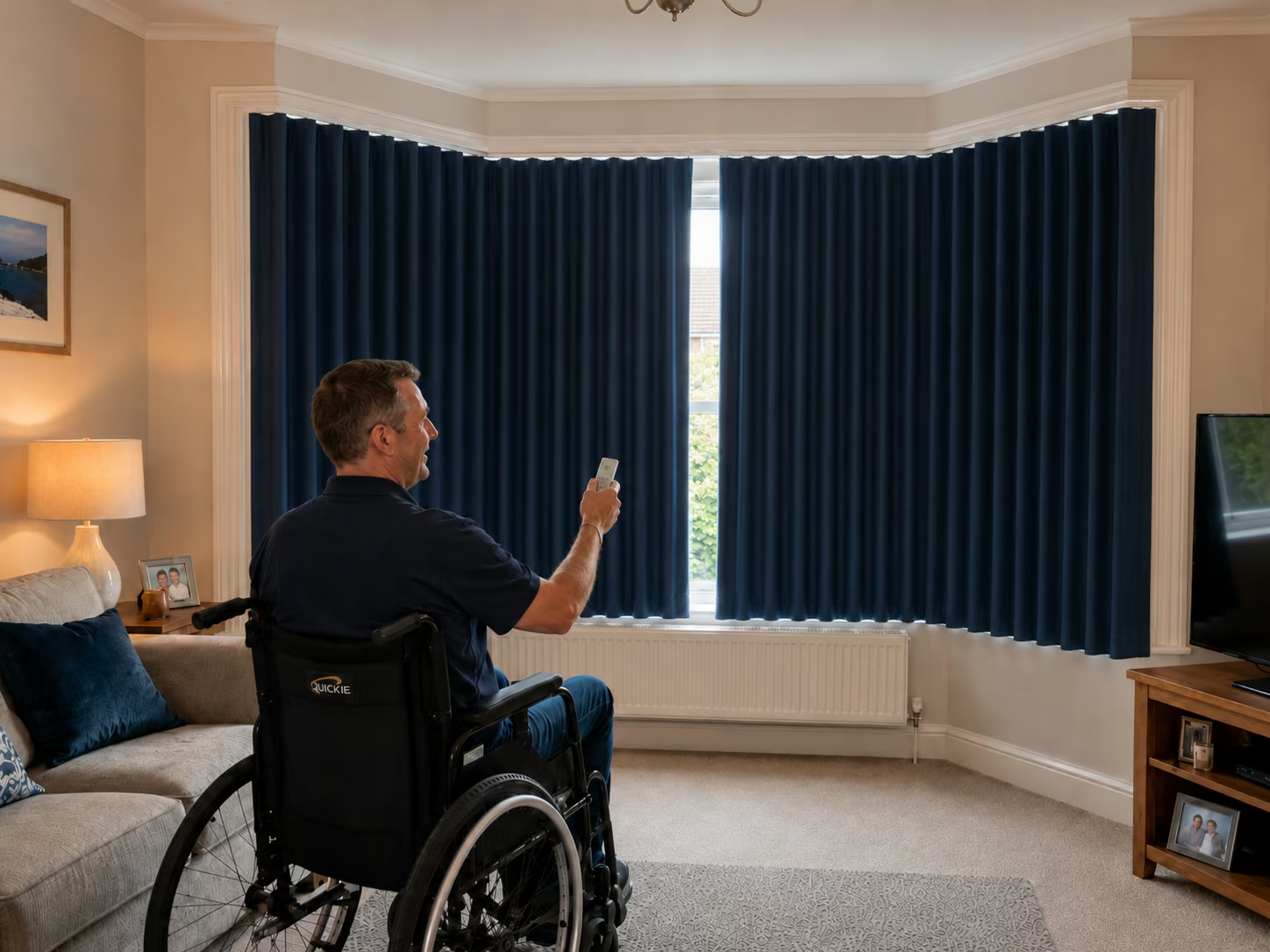
Electric curtains remove that entirely. Press a button and the curtains move on their own. That is the whole point.
Who This Applies To
The customers who contact us for this reason include a wide range: people with multiple sclerosis, Parkinson's disease, stroke survivors, wheelchair users who cannot reach a high track, people with severe arthritis in their hands or shoulders, and individuals recovering from joint replacement surgery. We also hear from carers buying on behalf of a partner or parent, and from occupational therapists recommending home adaptations to clients.
The common thread is not the specific condition. It is that the person wants to manage their own home without relying on someone else to open the curtains for them.
How Electric Curtains Work in Practice
The Silent Gliss Autoglide 5100 is the system we fit most often for accessibility reasons. It runs on a discreet motor built into the track and is operated by a handheld remote, a wall-mounted button, or a smart home integration depending on what suits the person best. There is no cord to pull, no wand to reach for, no manual effort required.
The wall button option is particularly useful where someone has limited hand dexterity but can press a large switch. The remote works from across the room or from bed. For people who use smart speakers, the system can be connected so curtains open and close by voice.
The timer variants go a step further. The curtains open at a set time in the morning and close in the evening automatically. No interaction is required at all. This is genuinely useful for people with fatigue conditions where the effort of managing daily routines needs to be minimised, or for anyone who finds operating a remote device difficult.
For longer curtains that reach the floor, Touch&Go means the motor activates when the curtain is touched from floor level, which works well for some wheelchair users who can initiate the movement without needing to reach up to the track.
Occupational Therapist Referrals
A number of our customers come via occupational therapists. OTs assess a person's home and recommend adaptations to support independent living, and electric curtains are occasionally part of that picture, particularly where someone has bedroom curtains they cannot manage.
If you are an OT sourcing options for a client, we are happy to discuss requirements and provide product information to support the adaptation assessment.
Disabled Facilities Grants
Local councils in England, Wales, and Northern Ireland administer Disabled Facilities Grants (DFGs) to help fund home adaptations for disabled people. The grant is means-tested and administered by the housing authority. Electric curtains do not automatically qualify, but where they form part of a broader package of adaptations recommended by an OT, there may be a case for including them. It is worth raising with whoever is coordinating the adaptation assessment.
Installation
We handle installation throughout the UK. The tracks are fitted to the ceiling or wall, cabling is run neatly, and the system is set up and tested before we leave. If the person living in the property has mobility limitations, we work around that during the visit. We are used to fitting in occupied homes.
If you have questions or want to discuss a specific situation, the easiest thing is to get in touch. We can advise on which system fits the window, the room, and what the person needs.
Shop our range
Browse the products mentioned in this article