How electric curtains work: what's inside the track

Reviewed by David Coleman, Website Manager
Reviewed 7 May 2026
If you've never seen an electric curtain track in operation, the question that usually comes up before you buy one is what's actually happening when the curtains move. There's a motor in there somewhere, and a belt, and the curtains travel smoothly across the window without anyone touching them, but most articles on the topic don't really tell you how. This article opens up the box. The components are simpler than you'd think, and once you can picture the machine, the buying decisions get easier.
Three different products go by "electric curtains"
It's worth knowing which one you're looking at before you commit, because what's inside is different on each, and so is what they're suited to.
Track with a concealed end-motor
This is the Silent Gliss 5100 and the 5600. The track is an extruded aluminium profile that mounts to the wall or ceiling, and the motor sits at one end of it, hidden behind a slim end-cap. The curtain hangs from carriers that travel along the inside of the profile. From the room you see the curtain moving, you don't see the motor. This is the most common type and the one most people picture when they hear "electric curtains".
Electric curtain pole
This is the Silent Gliss Metropole. The motor sits inside a hollow 50mm tube and drives the rings along the outside, so it looks like a regular decorative curtain pole from the room. There aren't many products like this on the UK market. The mechanism is similar in principle to a track, but the components are arranged differently because they have to fit inside the tube.
Retrofit clip-on motors
Products like SwitchBot Curtain or Aqara. These aren't a track at all. They clip onto your existing manual track and grip the leading edge of the curtain, then crawl along the track pulling the curtain with them. It's a different mechanism entirely. They're a short-term workaround if you can't fit a proper track, not a permanent solution. We don't sell them.
Inside the track
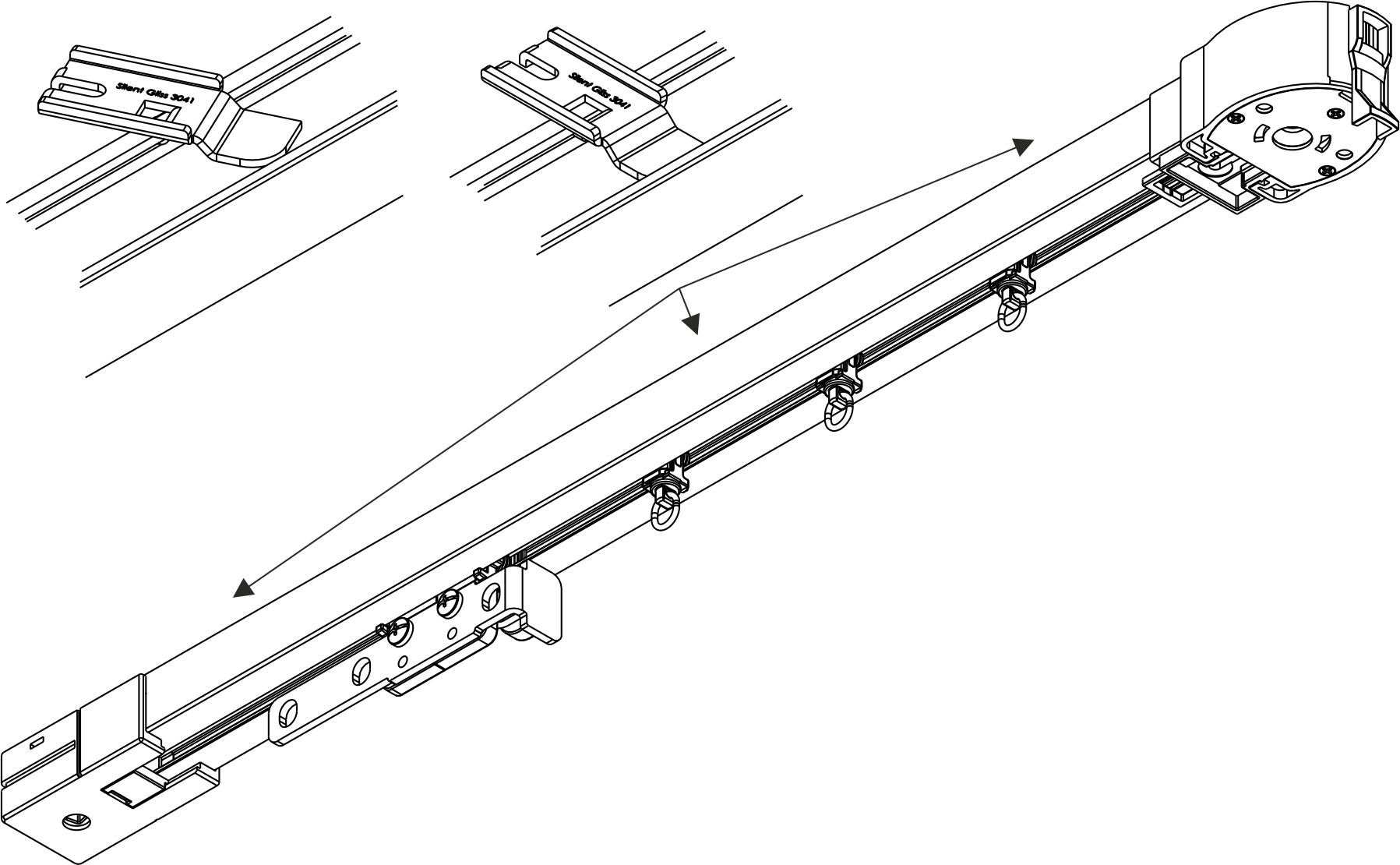
If you took the end-cap off a 5100 on a workbench and looked along its length, the picture above is what you'd see. The Silent Gliss part codes are in brackets next to each component, because if you're going to read about the inside of the machine you might as well know what each part is called.
The profile (SG 10925) is an extruded aluminium channel, made to your exact length and bendable for bay windows down to a 30 cm radius. The shape of the cross-section does two jobs at once. It's the structure that holds the track straight along the wall or ceiling, and it's the rail that the carriers run along.
The drive belt (SG 10825) is a continuous loop of toothed rubber belt that runs the full length of the track and back. It's the part that physically moves the curtain. The belt is threaded along the inside of the profile, around a guide return at the far end (SG 10940), then back along the other side and around the motor's drive spindle at the near end. The motor turns the spindle, the spindle turns the belt, the belt moves the carrier, the carrier moves the curtain.
The master carrier (SG 10822) is a small plastic glide block clamped to the belt at one point, with a belt connector arm (SG 10823) and pin (SG 10824). The leading edge of the curtain attaches to the master carrier with a hook (SG 3582). When the belt moves, the master carrier moves with it, and the leading edge of the curtain follows.
The slave gliders (SG 10931, supplied at ten per metre) are the rest of the carriers, and they aren't attached to the belt. They're free-running plastic glide blocks that look like the carriers on any standard curtain track. They run loose along the profile, and the leading edge of the curtain pulls them along by the curtain heading itself as it travels. That's why the curtain stacks at one end when it opens, the leading edge gathers the rest as it goes.
The end-stop (SG 11295) is a small physical buffer at the far end of the track that marks the maximum open position. Working alongside it is an electronic end-stop in the motor itself, which counts revolutions of the drive spindle to know exactly where the carrier is along the track at any moment. This is what lets you program intermediate positions for part-open or part-close, the motor counts to those revolution numbers and stops there.
The 5100 has a maximum length of 6 metres and supports curtains up to 25 kg on standard rollers. The Wave system, which is the next section, runs a different maximum because the gliders are arranged differently.
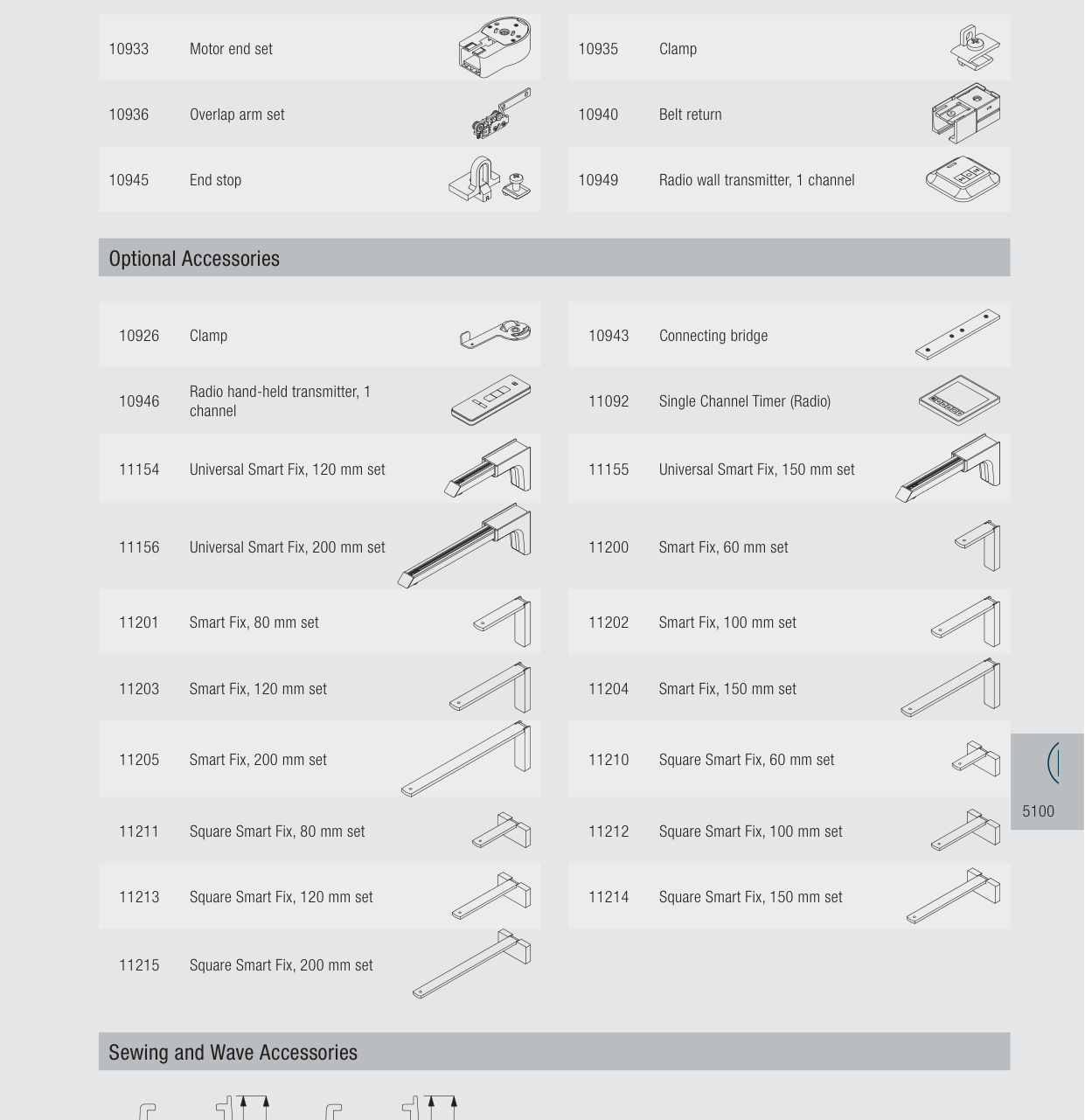
The diagram above is the SG parts board for the standard components and the optional accessories you can specify on a 5100. The standard components are what comes inside every 5100 you order. The optional accessories are the controls and brackets you choose at the configurator.
How the Wave system works
If you've seen a Silent Gliss curtain that hangs in a continuous, evenly-spaced S-curve from top to bottom rather than a random natural drape, that's the Wave system. It's an option on the 5100 (and the 5600) that gives the curtain the contemporary, architectural look that gets specified for hotels, show flats and modern homes. The wave isn't natural drape, it's mechanically held by an internal cord that connects the gliders together at fixed spacing.
The standard slave gliders are replaced with Wave gliders linked by a glider cord. Two cord versions are available, the 80 mm cord (SG 10905) which produces an 80 mm wave depth, and the 60 mm cord (SG 10906) for a tighter 60 mm wave. The curtain itself is sewn with Wave curtain tape (SG 6349) which has pockets at intervals matching the cord, plus a top hemming tape (SG 6363) for the heading finish. Each pocket on the tape locks to a Wave hanger (SG 6365) which sits on the corresponding glider. The result is that every fold of the curtain is fixed to a known position along the track, so the wave is identical from the first metre to the last.
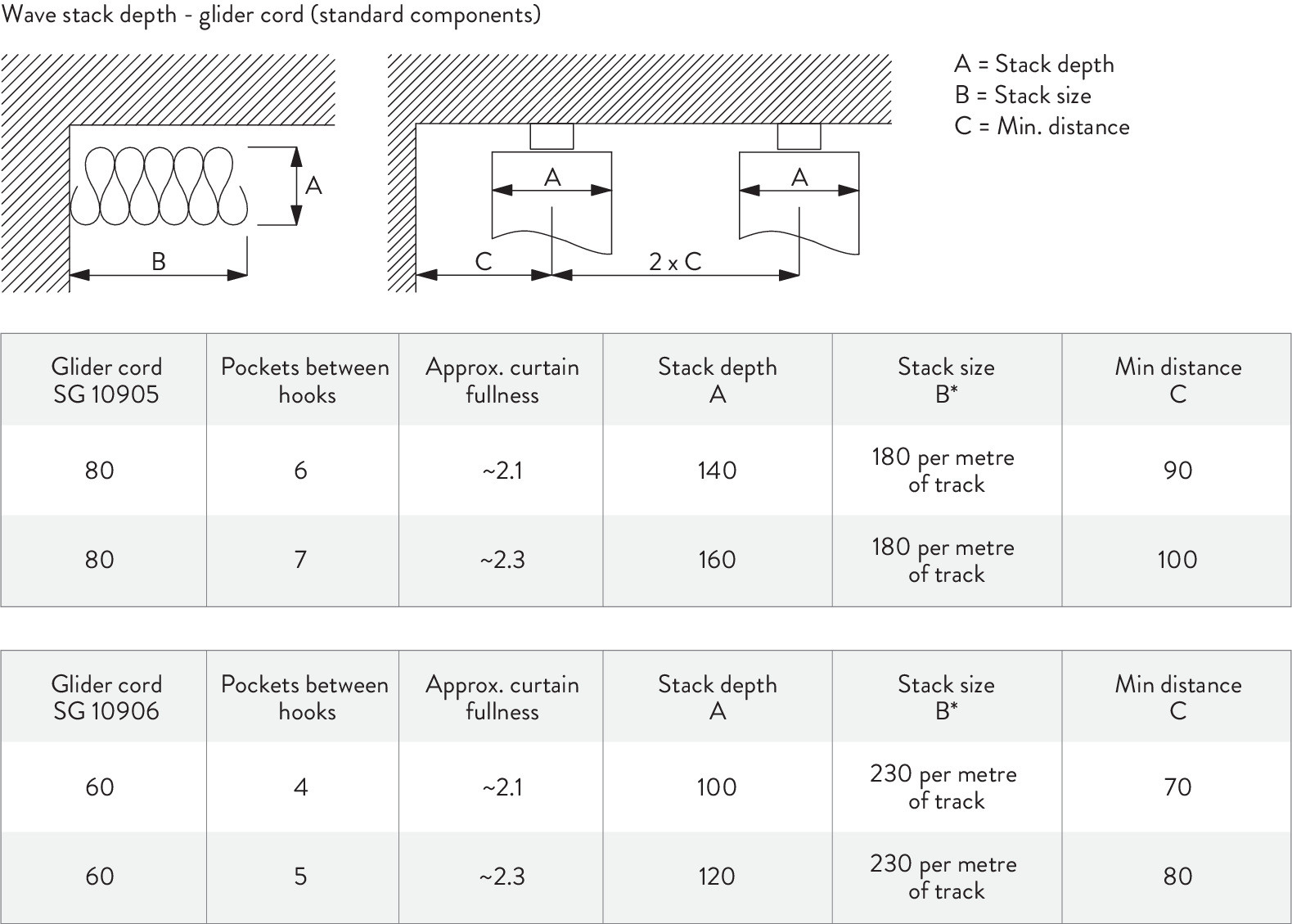
The diagram above shows what changes between the two cord options. The 80 mm cord gives a deeper wave (140 mm or 160 mm stack depth depending on curtain fullness, around 180 mm of stacked curtain per metre of track when fully open). The 60 mm cord is shallower (100 mm or 120 mm stack depth, 230 mm of stacked curtain per metre). 80 mm is the more common pick for residential because it gives the more sculptural look, 60 mm is preferred when wall space is tight and you want the curtains to stack more compactly.
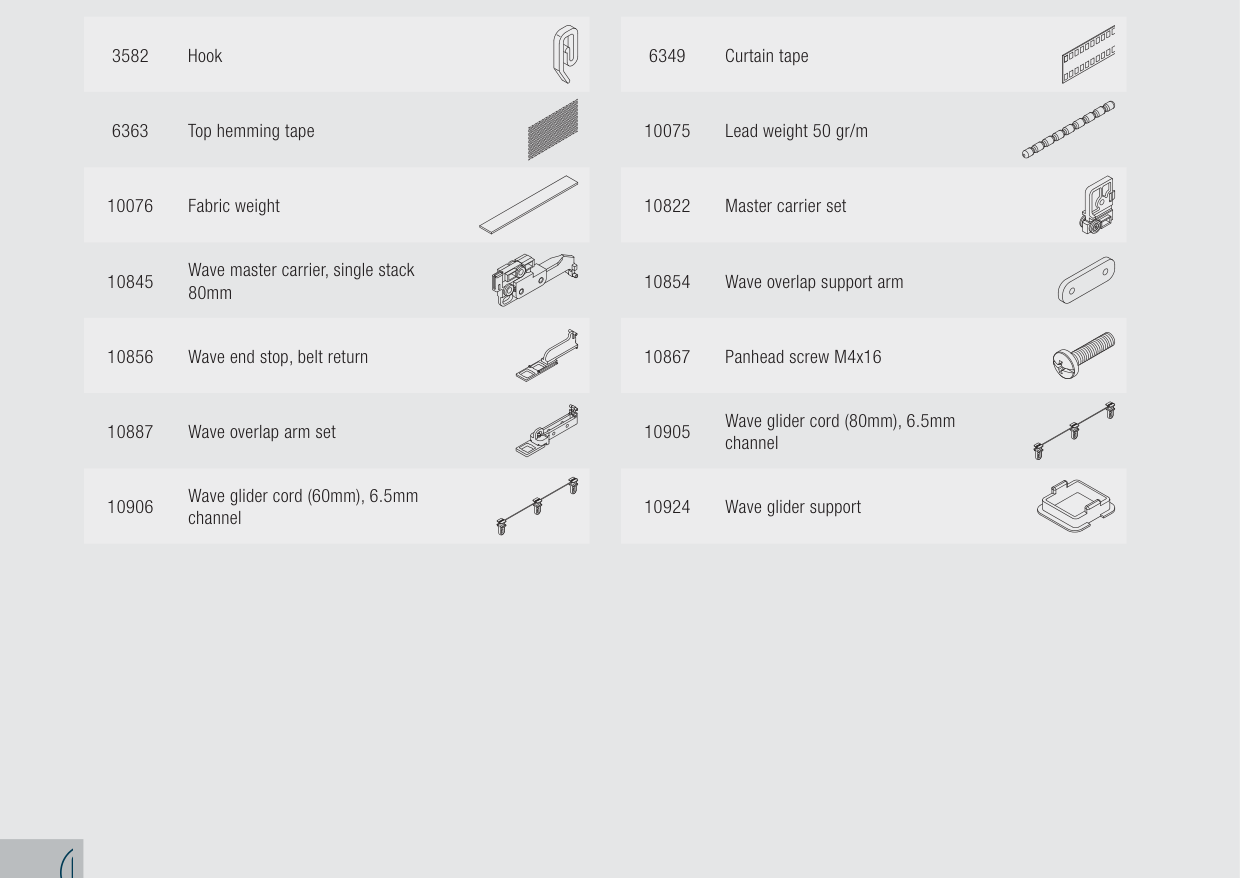
The curtain-side parts are shown above. The Wave system isn't something you can retrofit by buying different gliders, it has to be specified at the order, because the curtain itself needs the matching tape sewn in. If you've already got curtains and you'd like to convert them to Wave, talk to us about it before you buy the track, because the curtain workroom side of the job is part of the order.
What the motor actually does
The standard 5100 motor (SG 5190) is one component out of several, and its job is narrower than you might expect. It spins a small drive spindle that engages the rubber belt. That's all. It doesn't carry any of the curtain weight directly, the load is on the carrier and gliders that run along the profile. This separation is why the same motor variant can serve a 1-metre track or a 5-metre track without any change, the load on the motor is just the drive friction along the belt, not the fabric weight on the curtain.
The motor is a 100-240V AC unit with a built-in radio receiver, soft-start and soft-stop, electronic end-stop, and an electronic revolution counter that tracks position with no upper limit on the number of revolutions it can log. It's an external clip-on unit at the end of the track behind a slim cover, so it can be lifted off and swapped if it ever needs to be. There are two alternative motor variants on the 5100 for AV and integration jobs, the SG 5192 (24V DC version) and the SG 5193 (mains-controlled with no radio receiver, used when control comes from a hard-wired switch rather than a remote). The 5600 motor is a more substantial unit built into the end of the track itself, designed for heavier curtains and longer runs.
How it knows when to stop
When the motor receives a signal to open or close, it doesn't run at full speed and then slam to a halt at the end of the travel. It runs a soft-start at the beginning, accelerates to full speed, then soft-stops as the carrier approaches the end position. That's why the motion looks and feels controlled rather than jerky, and it's also what protects the belt and the gears, because hard accelerations and decelerations are what wear out the cheaper systems on the market.
The way the motor knows where the ends are is set during installation. You run the curtains across the track once with the motor in setup mode, the motor logs where the carrier stops at each end as a count of drive-spindle revolutions, and from then on it counts revolutions from one logged position to the other to know exactly where the curtain is. If you've programmed intermediate positions for part-open or part-close, the motor stops at those revolution counts instead.
What happens when the power's out (and why pulling them by hand is fine)
A few things often surprise people the first time they see a Silent Gliss in action.
The first is that you can pull the curtains by hand. It's not just allowed, it's a designed feature. Tug the leading edge of the curtain in either direction and the motor takes over and runs it the rest of the way to fully open or fully closed. This is called Touch and Go and it's built into every 5100, every electric Metropole, and every 5600 up to 12 metres long. It works alongside the remote, the timer and the app, so you can use whichever's nearest to you at the time.
The second is that during a power cut you just draw them by hand like a normal curtain track. All Silent Gliss tracks have a manual override built in, so an outage doesn't trap the curtains in whatever position they were in when the power went off. The motor's gearbox is designed to disengage cleanly when the curtains are pulled by hand, which is why neither the Touch and Go feature nor the power-cut behaviour does any damage to the system. When the power comes back, the motor picks up where it left off.
This is one of the most common questions we get from people who've never owned a motorised track before, and the answer reassures most of them. You aren't trapped, you can interact with the curtains exactly the way you would with a manual track, and the motor is built to expect it.
What to expect in practice
The motion is unhurried rather than rushed, partly because of the soft-start and soft-stop and partly because Silent Gliss runs the motor at a deliberate pace rather than the fastest the gears can handle. Most people find it feels more elegant than they expected, you don't get the slam-open and slam-shut quality of cheaper motors.
The motor itself is virtually silent. Most of the sound you hear when the curtains are running is the gliders moving along the profile and the curtain fabric brushing against the track, and that's the same sound you'd hear pulling them by hand. After a week most customers stop noticing it.
Now you know how it works, the rest of the buying decision is easier
The full range of electric curtains is on the main category page. The openers and remotes article covers how you tell the motor to move once it's installed (remote, wall switch, timer, app, voice). The install guide covers what's involved in fitting one yourself or having a fitter do it. The honest worth-it guide covers when they earn their money and when a manual track is the better call.
If you've got a question that's not covered here, the contact form is on the electric curtains page or you can call 01543 279996 if you'd rather have a chat about it.
Diagrams reproduced from Silent Gliss product information. Discount Electric Curtains is an authorised Silent Gliss dealer.
Shop our range
Browse the products mentioned in this article
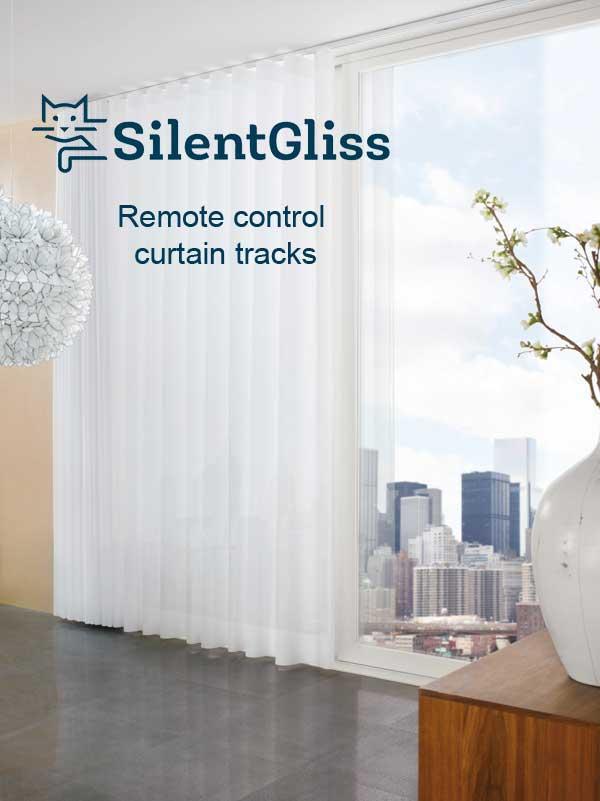
Silent Gliss Autoglide 5100
The UK's best-selling premium electric curtain track. Whisper-quiet, remote or timer control.
View product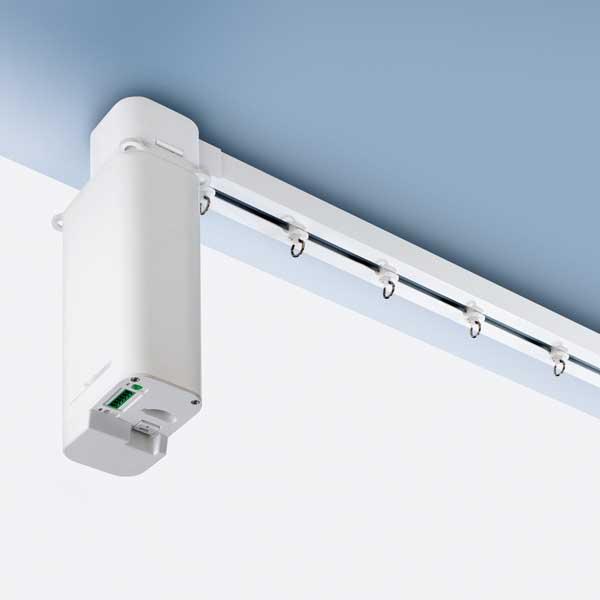
Silent Gliss 5600
Heavy-duty electric curtain track for large, heavy curtains and commercial spaces.
View product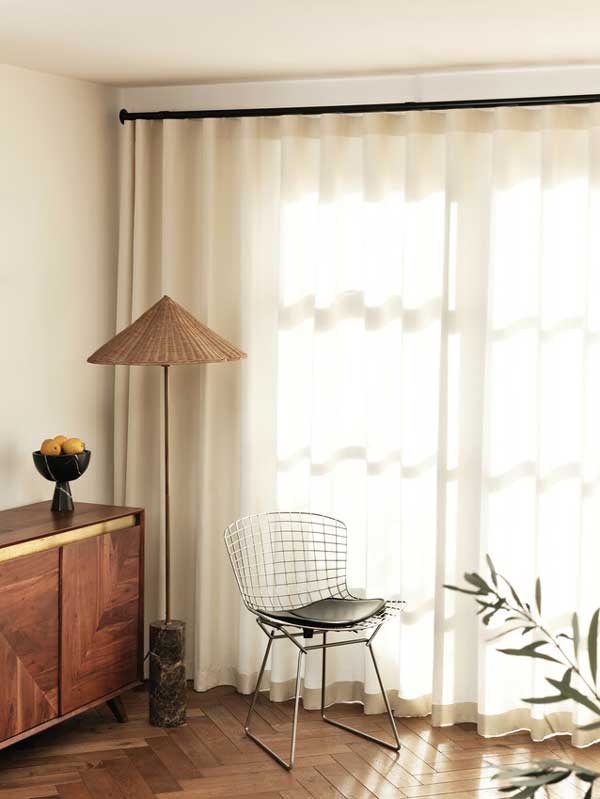
Silent Gliss Metropole
The only electric curtain pole. Classic decorative look with a whisper-quiet motor.
View product